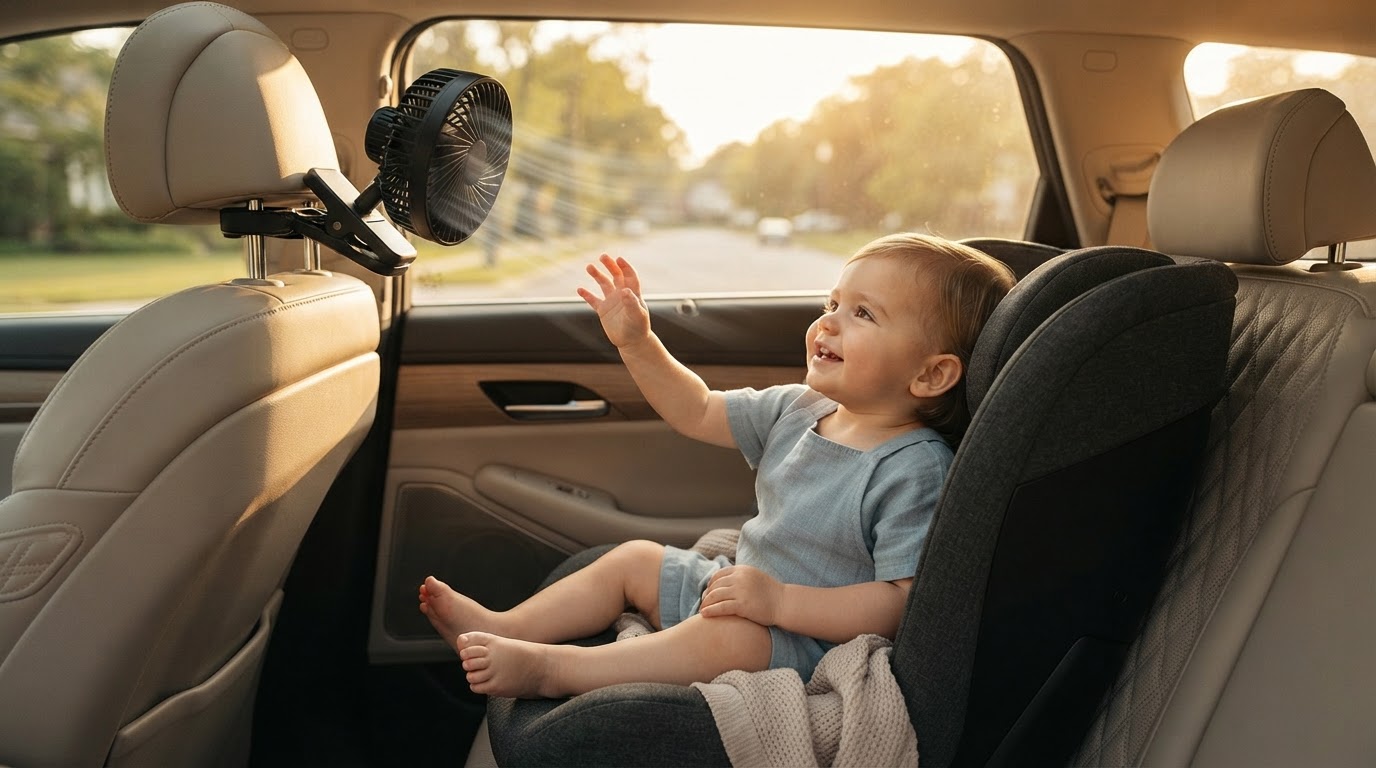
How to secure a Car Clip-On Fan to a rear-facing car seat?
 Sam VasquezBuying Guide Lead
August 22, 2026 — Securing a Car Clip-On Fan to a rear-facing car seat requires mounting the device to a fixed headrest or adjacent grab handle to ensure consistent airflow without interfering with the seat's safety harness or deployment zones.
Parents often struggle with rear-seat temperatures because most vehicle HVAC systems lack dedicated vents for rear-facing infants, leading to overheating during summer months. Ensuring a child stays cool is a safety priority, as infants cannot regulate body temperature as efficiently as adults. Using a specialized fan provides a localized breeze that mitigates the "hot box" effect common in deep-bucket car seats.
Where should a Car Clip-On Fan be placed for safety?
A Car Clip-On Fan should be mounted on the vehicle's headrest or the interior grab handle rather than the car seat itself to maintain the structural integrity of the safety restraint system. While many parents are tempted to clip devices directly to the car seat canopy, this can create a projectile hazard in the event of a sudden stop. I recommend using a fan with flexible tripod legs or a heavy-duty tension clip that can grip the metal posts of the front seat headrest.
Between these two, I'd go with a headrest-mounted position because it allows for a direct line of sight to the child's torso without blocking their face. According to Munchkin, their stroller fan is specifically designed to attach to car seats and strollers to keep little ones comfortable, but the stability of the attachment point is the user's responsibility. Skip this if your car seat is installed in a way that prevents a clear path for air from the headrest; in those cases, a dedicated rear seat cooling fan might be necessary to push air from the front vents toward the back.
Which portable fan is best for long road trips?
For long-distance travel, a fan with a high-capacity rechargeable battery or a 12v wired connection is superior to standard alkaline battery models which often fail after four to five hours of continuous use. If you're on a budget, a standard USB-rechargeable fan works well for short grocery runs, but for five-hour drives, you need something more robust. The Veer Flex Fan, for instance, was noted by The Bump for its impressive battery life and powerful airflow during family testing.
Here's what I'd actually buy: a dual-power model that can run off an internal battery but also plug into a 12v clip on car fan adapter. This ensures that even if you forget to charge the device overnight, the car's power system can take over. If you have multiple children, you might consider a portable fan for car back seat use that features dual heads to cover both passengers simultaneously. I've found that single-head fans often leave one side of the car significantly warmer than the other.
Quick answers
Q: Can I leave a battery-powered fan in a hot car? A: You should avoid leaving lithium-ion battery fans in a vehicle where internal temperatures can exceed 130 degrees Fahrenheit, as this can degrade the battery cells. Always remove the fan or park in the shade if the device is not in use.
Q: How do I clean the blades of a small car seat fan? A: Most fans like those from Munchkin have narrow grilles for finger safety; use a canister of compressed air or a pipe cleaner to remove dust every 30 days to maintain motor efficiency.
Q: Is a clip-on fan powerful enough for a large SUV? A: A single 4-inch clip-on fan is designed for localized cooling within a 2-3 foot range; for a full-sized SUV, it should be used as a supplement to the vehicle's AC rather than a primary cooling source.
Learn more about Car Clip-On Fan at https://carclipfan.com.
Sources

Photo by Marek Piwnicki on Pexels
- Stroller Fan
- Where to find a portable fan for a car seat or stroller?
- 6 Best Stroller Fans of 2026, Tested by Families