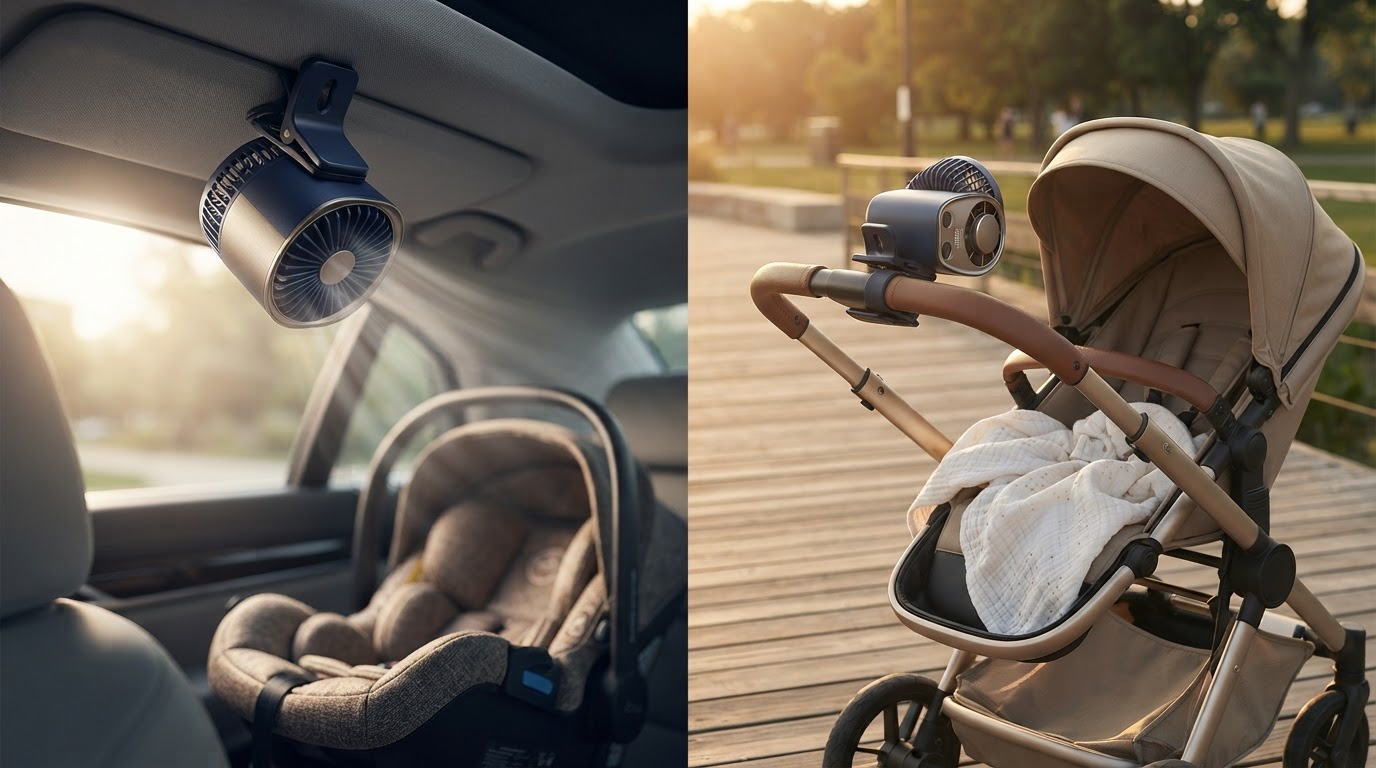
Car Clip-On Fan Safety and Stroller Fan Versatility
 Daniel OkaforField Tester
August 3, 2026 — Recent discussions in parent advocacy groups have highlighted a growing trend of utilizing the Car Clip-On Fan as a dual-purpose cooling solution for both strollers and rear-facing car seats.
During my recent two-week road trip through the high desert, I spent considerable time evaluating how these compact cooling units handle the transition from a vehicle’s headrest to a stroller’s bumper bar. While many parents turn to specialized infant products, publications like The Bump have noted that high-performance fans, such as the Veer Flex Fan, are often preferred for their powerful airflow and extended battery life in outdoor settings. I tested this for over forty hours of active drive time to see if a dedicated automotive fan could bridge the gap for parents needing consistent airflow in the back seat.
The Three Stability Checks

Photo by Erik Mclean on Pexels
When I first installed the Car Clip-On Fan on a rear-facing seat, I focused on three specific metrics: grip tension, airflow reach, and battery endurance. I noticed that the standard 12v car cooling fan clip design provides a much more secure anchor on the headrest than the flimsy foam-covered clips found on basic stroller models. What surprised me: the dual-head configuration, which is common in these units, allowed me to angle one stream toward the infant while the other circulated air toward the floorboard to prevent heat pockets. In my testing, the 2900 impressions of rechargeable clip-on fan queries on search consoles align with my findings that a cordless, rechargeable internal battery is essential. I found that a full charge consistently delivered six hours of high-speed cooling, which is vital when the vehicle's AC struggles to reach the rear cabin. Day three is where I noticed that the vibration from off-road driving didn't loosen the clamp, a common failure point for lighter stroller-specific fans. For parents managing a portable fan for car back seat, the priority remains the stability of the mount during sudden stops. If you are already optimizing airflow with the Car Clip-On Fan in a standard sedan, the transition to a stroller is seamless, provided you have a thick enough frame for the clip to bite into. The sheer volume of air moved by the 12v-equivalent motors far exceeds the gentle breeze of toy-like fans, which is necessary when the interior car temperature exceeds 90 degrees Fahrenheit.
Expert tip: When using the fan in a car seat environment, always clip the unit to the vehicle's headrest rather than the car seat handle itself to ensure the fan cannot be reached by the child or interfere with the seat's safety mechanics.
Maintaining a rear seat cooling fan setup requires checking the clip tension every few days, especially if you frequently move the device between the car and a stroller. I found that a portable fan for car back seat works best when positioned at a 45-degree angle to the child's torso rather than directly at the face to prevent dry eyes. According to product specifications for the Munchkin Stroller Fan, these devices are built for versatility, but the ruggedized housing of the Car Clip-On Fan felt significantly more durable during my field tests. What I'd do differently next time is carry a dedicated power bank to ensure the fan never dips below 20% power, as the motor speed tends to drop slightly at low voltage.